News
Jelin Technology: Specializing in Image Processing System-on-Chip (SoC) Design
 2026.3.16
 News
News
 Jelin Technology: Specializing in Image Processing System-on-Chip (SoC) Design
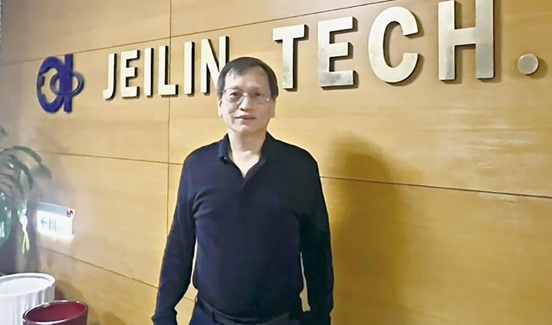
The Global Semiconductor Industry Enters the AI Era: Jeilin Technology Carves Out a Niche in the Image SoC Market
As the global semiconductor industry enters the AI era, the competitive landscape for chips is shifting rapidly. For most Taiwanese IC design companies, identifying a strategic position within a market dominated by giants is critical to long-term survival. Jeilin Technology, a specialist in Image Processing System-on-Chip (SoC), has avoided direct confrontation with industry titans; instead, Chairman Liang Chun-lin is leading the company to break through by focusing on niche markets.
Liang noted that Jeilin has spent years deepening its expertise in Image SoC design. The core strategy is to target the "mid-sized market"—specifically, application fields with global shipment volumes ranging from approximately 5 million to 20 million units. These markets are often too small for large-scale IC design firms to justify the required R&D investment, yet they offer significant growth potential for small-to-medium enterprises. By adopting this positioning, Jeilin has been able to avoid direct competition with industry leaders while steadily building its technical foundations and customer base.
Image Applications: The Primary Growth Engine for the Next Three Years
With Image SoCs as its central pillar, Jeilin's applications span action cameras, dashcams, and smart imaging devices. Liang stated that the image market is extensive, with demand stretching from consumer electronics to security surveillance. The company's primary growth drivers over the next three years will stem from imaging applications where it has not yet fully deployed.
Among these, action cameras and dashcams are regarded as Jeilin's two most critical future markets. Liang pointed out that while these products demand high image quality and processing power, their market scale remains in the mid-sized range, aligning perfectly with Jeilin's strategy. With the launch of the company's next-generation image chips, related products are being gradually integrated into customer designs, which is expected to drive revenue growth.
Regarding the security market, Liang observed that current mainstream image resolutions remain centered on 1080p and 2.7K. However, as AI image recognition technology is gradually integrated, resolution and computational requirements will steadily rise. Although high-resolution security products may not achieve universal adoption in the short term, they possess long-term development potential. Given that global shipments of security equipment can reach hundreds of millions of units annually, the security sector remains a vital application market for image chips.
Beyond imaging devices, Jeilin is integrating AI technology into its core development. Liang highlighted the company's proprietary parallel processing architecture, MAPP (Multi-core Array Parallel Processor), which simultaneously supports AI computation, image processing, and communication algorithms. MAPP will serve as the foundational architecture for the company's future AI chips. Using this technology, Jeilin plans to launch next-generation AI chips with higher computing power to expand into more Edge AI applications.
In terms of product planning, Jeilin's current flagship products utilize the mature 28nm process. Liang believes that for consumer electronics, mature processes offer the optimal cost-benefit ratio and will remain mainstream for the next few years. In the next phase, Jeilin will introduce a higher-performance AI computing platform, with plans to release an AI chip boasting approximately 10 TOPS of computing power by 2027, targeting applications such as drones, industrial equipment, and automotive imaging.
However, Liang admitted that not all trending markets are suitable for IC design investment. For example, while the drone and robotics industries carry high output value, chip shipment volumes remain relatively limited, making them a less-than-ideal fit for IC design firms. Consequently, when evaluating markets, the company prioritizes shipment volume and long-term market scale.
Two Competitive Advantages Driving Jeilin's Growth
Jeilin's chip designs are also highly competitive in terms of die area and total system cost. Liang stated that Jeilin's chips are typically 15% to 40% smaller than those of its competitors. At the same time, through architectural optimization, the company can achieve equivalent performance using lower-cost memory and peripheral components, creating a systemic cost advantage.
Looking ahead at the AI industry, Liang believes that while AI applications are currently concentrated in cloud data centers, they will gradually migrate to end-user devices over the next few years, forming the Edge AI market. PCs and imaging devices are likely to be among the first terminal products to adopt AI computation, followed by the gradual integration of AI image recognition into smart monitoring and security systems.
"The explosion of AI terminal applications will not happen overnight, but it will certainly emerge gradually," Liang said. "We do not necessarily need to capture the largest market, but we aim to be the best in specific domains." As AI models become more lightweight and chip energy efficiency continues to improve, more devices will possess AI capabilities, creating new opportunities for both image chips and Edge AI chips.